Following on from the Cornflower Roadshows, Simon Nutbrown explains how bespoke products rooted in a sense of place don’t compete on price, they compete on meaning.
One of the phrases we use a lot at Cornflower is “Sense of Place.” It’s simple, but it carries a lot of weight.
A visitor to a museum, gallery, heritage site, or cultural attraction, is not just consuming information. They’re stepping into a specific story, in a specific location, with its own history, atmosphere, and emotional resonance. That is Sense of Place, and it is what makes the visit memorable. Crucially, it’s also what makes the retail opportunity unique.
The most successful museum products don’t just sit at the end of the visit, they extend it.
Products as a reflection of place
A truly bespoke product reflects where it comes from; it couldn’t exist anywhere else.
That might mean drawing directly from the collection, the architecture, the landscape, the archives, or the stories that define the institution. Or it might be subtler: a colour palette that echoes the building, a line of text that captures the tone of the interpretation, or a material choice that feels appropriate to the setting. What matters is that the product belongs there.
When a visitor picks up this product in your shop, consciously or not, they understand that this is not a generic souvenir; it’s something rooted in that place, that visit, that moment. Crucially, it’s only available there.
Exclusivity changes behaviour
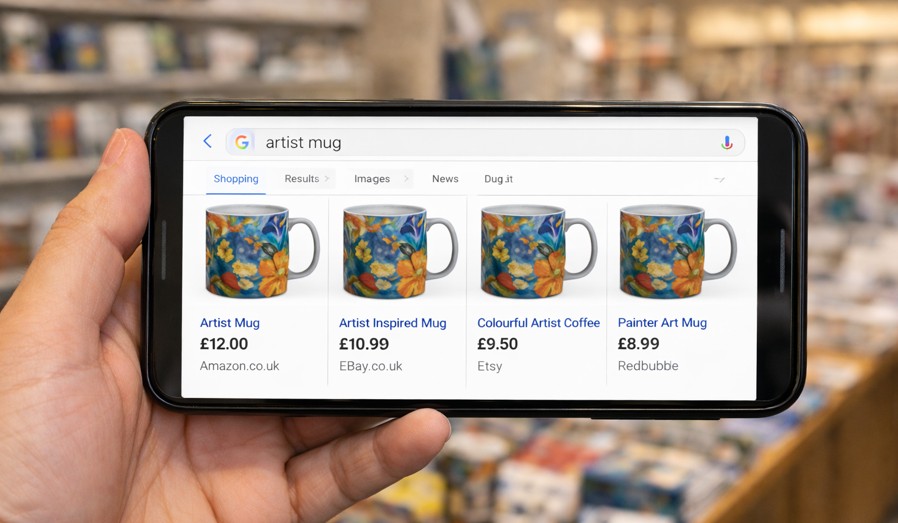
That exclusivity has a powerful effect on buying behaviour. We’ve all seen it: someone standing in a shop, phone in hand, quickly Googling to see if they can get the same thing cheaper elsewhere. It’s a perfectly rational response, and one that off-the-shelf products, available elsewhere, invite.
Bespoke products short-circuit that behaviour. If the item is exclusive to the institution, there is no price comparison to be made. There’s no alternative retailer, no online shortcut, no “I’ll get it later.” The choice becomes immediate and emotional rather than transactional.
Do I want this as a reminder of today? As the answer to this question is tied to the experience itself, the decision is often made there and then. The product becomes a physical anchor for the visit, a way of taking something intangible home.
The moment matters
However much we might hope it's not the case, museum visits are often fleeting. Even the most memorable ones fade surprisingly quickly once you’re back in everyday life.
Bespoke products work because they capture the moment while it’s still alive. They enable the visitor to take home and remind them of the memory and emotion of a visit, in short the sense of place.
This is one of the reasons why products designed specifically for an institution consistently outperform generic equivalents. They don’t compete on price alone they compete on meaning.
Visitorsplaining: products as ambassadors
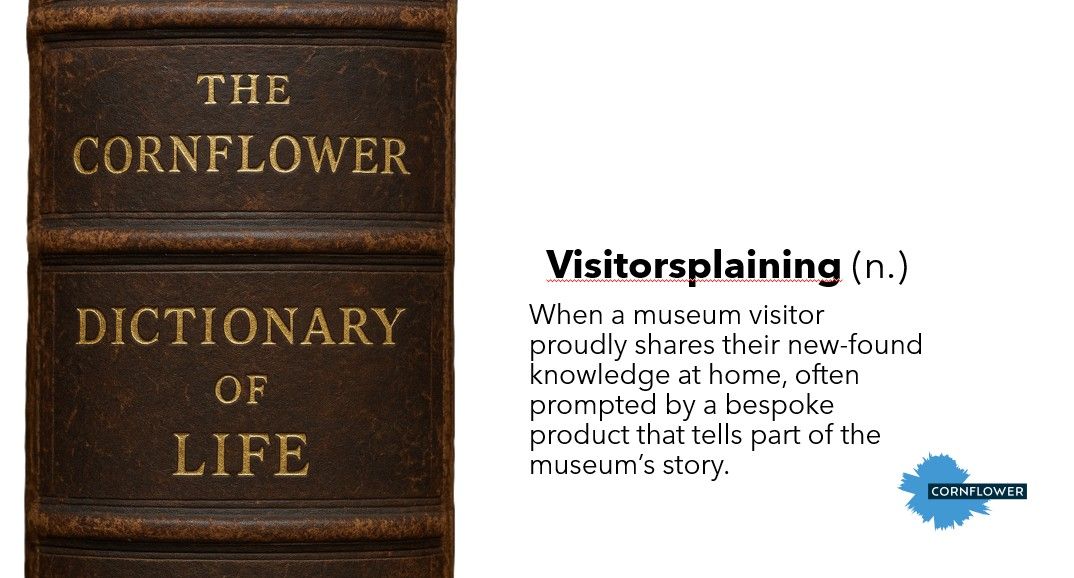
This is where the idea of Visitorsplaining comes in.
Long after the visit, those products continue to do quiet work on behalf of the institution. A tote bag on a train, a mug in an office kitchen, a notebook on a desk, each one prompts a question.
“Where did you get that?” Just like that the visitor becomes an ambassador. They explain the place, the story, the exhibition, the experience. Not because they were asked to, but because the product invites the conversation.
That’s Visitorsplaining in action: visitors sharing knowledge and enthusiasm organically, through objects that carry meaning. In that sense, a well-designed bespoke product is more than a retail line. It’s a communication tool, a memory trigger, and a piece of advocacy all rolled into one.
Designing with intent
None of this happens by accident. Creating products that genuinely reflect a sense of place requires close collaboration, careful listening, and a willingness to move beyond off-the-shelf solutions. It means asking not just what will sell, but what feels right for this institution, this audience and this story. When that alignment is there, the results are tangible: stronger emotional connection, higher conversion, fewer price objections, and products that feel meaningful. Perhaps most importantly, visitors leave with something that continues the relationship long after they’ve walked out of the door.
A final thought
Museum shops are not just retail spaces. They are the final chapter of the visit, and have the potential to be the longest-lasting one. Bespoke products, rooted in a genuine sense of place and available nowhere else, can achieve that. They respect the visitor, reflect the institution, and quietly do their work out in the world, one conversation at a time. That’s why they matter, and why hopefully that phone to compare a price remains in the visitor's pocket.